
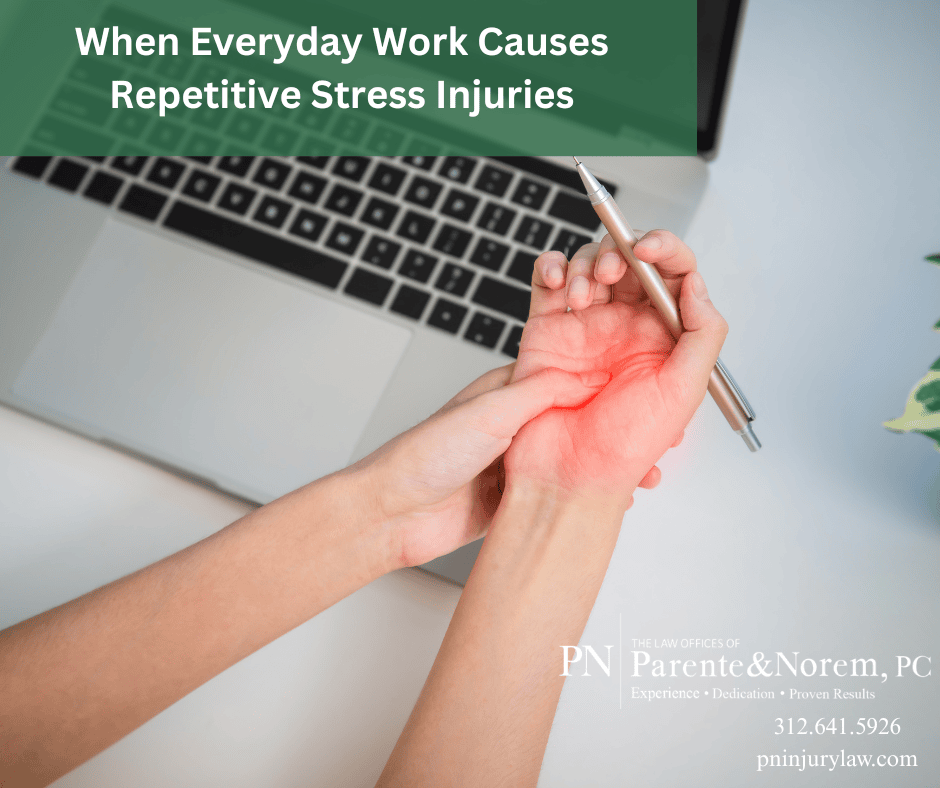

Not every workplace injury happens in a single dramatic moment. For many Illinois workers, the damage builds slowly, one shift, one motion, one lift at a time, until pain that started as a minor annoyance becomes a condition that affects their ability to work and live. These are repetitive stress injuries, and they can be just as disabling as any sudden accident. If your body has worn down from the demands of your job, you may have rights under Illinois law that you didn't know you had.
What Are Repetitive Stress Injuries?
Repetitive stress injuries, sometimes called repetitive trauma or cumulative trauma injuries, develop from performing the same movements over and over across weeks, months, or years. The strain accumulates in muscles, tendons, joints, and nerves until the tissue can no longer keep up. Some of the most common examples we see among Chicagoland workers include:
- Carpal tunnel syndrome: Common among office workers, assembly line employees, and anyone using vibrating tools, this condition develops when repeated hand and wrist motions compress the nerve running through the wrist, causing numbness, tingling, and weakness.
- Back injuries: Warehouse workers, delivery drivers, nurses, and laborers who repeatedly lift, bend, and twist can develop chronic back conditions, including disc problems that worsen over time.
- Rotator cuff injuries: Painters, electricians, drywall hangers, and others who work overhead put constant stress on the shoulder, gradually fraying the tendons that keep the joint stable.
- Knee wear in the trades: Flooring installers, tile setters, plumbers, and carpenters who spend their days kneeling and crouching often experience cartilage breakdown and chronic knee damage.
The common thread is that the injury doesn't come from one event, it comes from the job itself, performed day after day.
Are Gradual Injuries Covered Under Illinois Workers' Compensation?
Yes. This is one of the most important things injured workers need to understand. The Illinois Workers' Compensation Act covers repetitive trauma injuries, not just sudden accidents. Illinois courts have long recognized that an injury caused by the cumulative effects of work can be compensable, even when there is no single incident to point to.
Because these injuries develop gradually, Illinois uses what's often called a "manifestation date" which is generally the point at which the injury becomes apparent and the worker knows, or should know, that it is connected to their job. That date matters, because it can affect deadlines for reporting the injury and filing a claim. Workers' compensation cases in Illinois carry strict notice and filing requirements, and missing them can jeopardize an otherwise valid claim. Acting promptly, and getting guidance early, helps protect your rights.
Why Is Proving a Work Related Repetitive Injury So Difficult?
The biggest challenge with repetitive stress claims is causation. Causation means showing that the job, rather than aging, hobbies, or general wear and tear, caused or aggravated the condition. Insurance companies frequently argue that a worker's carpal tunnel, bad back, or worn knee is simply a natural part of getting older or the result of something outside of work.
These arguments can be difficult, but they are not the final word. Illinois law recognizes that work does not have to be the only cause of an injury for it to be compensable, it generally needs to be a contributing cause. Even so, defending against these insurance tactics takes evidence, and that evidence often makes the difference between a denied claim and an approved one.
How Medical Documentation Strengthens Your Claim
Because repetitive injuries lack a single accident to anchor them, medical records become the backbone of your case. Strong documentation typically includes:
- Early and consistent treatment: Reporting symptoms and seeing a doctor as soon as problems appear creates a record that connects your condition to your work.
- A clear description of your job duties: Telling your physician exactly what your work involves helps establish the link between your tasks and your injury.
- Medical opinions on causation: A doctor's assessment that your work activities contributed to your condition can be pivotal.
The more thoroughly your condition and its connection to your job are documented, the harder it becomes for an insurer to dismiss.
Talk to The Law Offices of Parente & Norem, P.C. About Your Injury Today
If everyday work has left you with a lasting injury, you don't have to sort out your rights alone. The attorneys at Parente & Norem have decades of experience helping injured Illinois workers pursue the benefits they're entitled to. We offer free consultations and handle cases on a contingency fee basis, meaning you owe no attorney's fees unless we recover for you. Contact our Workers Compensation department at 312-641-5926 today or fill out a form here on our website.
