
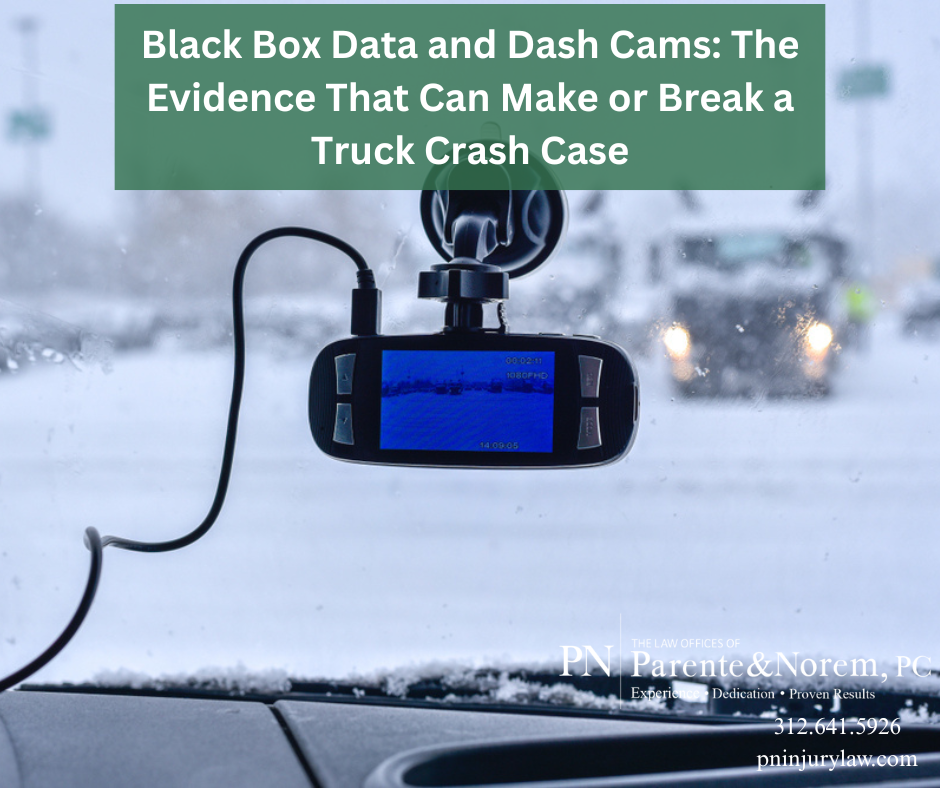

After a serious collision with a semi-truck, the most important evidence in your case may not be at the crash scene at all. It may be sitting inside the truck itself, in an electronic control module, a dash camera, or a fleet telematics system quietly recording exactly what happened in the seconds before impact. This digital evidence can make or break a truck crash case, but only if it is preserved before it disappears.
At The Law Offices of Parente & Norem, P.C., our attorneys move quickly after commercial truck accidents to identify and secure this evidence on behalf of injured clients throughout Chicagoland.
What Is a Truck's "Black Box"?
Most commercial trucks on Illinois roads are equipped with an electronic control module (ECM), sometimes paired with an event data recorder (EDR). Much like the black box on an airplane, these systems capture a detailed snapshot of the truck's operation, including:
- Vehicle speed in the moments before a crash
- Brake application: when the driver braked, and how hard
- Throttle position and engine RPM
- Sudden deceleration events
- Hours of operation and driving time
That last category can be critical. Federal hours-of-service rules limit how long truckers may drive without rest. If ECM data shows a driver exceeded those limits, it may support a claim that fatigue contributed to the crash. Evidence that would be nearly impossible to prove through witness testimony alone.
How Do Dash Cams Strengthen a Truck Accident Claim?
Many trucking companies now equip their fleets with dash cameras, and they often record in two directions:
Outward facing cameras capture the road ahead, documenting traffic conditions, lane position, following distance, and the actions of every vehicle involved in the collision.
Inward facing cameras record the driver, revealing whether they were texting, drowsy, distracted, or otherwise inattentive at the wheel.
Video evidence is uniquely powerful because it shows a jury what happened rather than asking them to reconstruct it from competing accounts. When dash cam footage confirms that a truck driver drifted across a lane line or failed to brake, liability disputes often narrow considerably.
What Is Telematics Data, and Why Does It Matter?
Beyond the black box and cameras, modern fleets run sophisticated telematics systems that transmit real time data back to the trucking company. These systems can log GPS location history, speed patterns, hard braking alerts, route information, and even maintenance diagnostics. Telematics records can corroborate or contradict a driver's version of events and may reveal whether the company knew about unsafe driving behavior long before the crash.
Data Gets Overwritten, So Quick Action Is Needed
Here is the hard truth about digital truck crash evidence, it does not last. Many ECM systems record on a continuous loop, overwriting older data as the truck returns to service. Dash cam footage may be retained for only a matter of days or weeks. Telematics records can be purged under routine data retention policies. Every day the truck stays on the road is a day critical evidence may be disappearing.
How Does a Spoliation Letter Protect the Evidence?
One of the first steps an experienced truck accident attorney takes is sending a spoliation letter, which is a formal legal notice demanding that the trucking company preserve all evidence related to the crash, including ECM and EDR data, dash cam footage, telematics records, driver logs, inspection reports, and maintenance files. Once a trucking company receives this notice, destroying or allowing that evidence to be lost can carry serious legal consequences under Illinois law. A prompt spoliation letter takes evidence preservation out of the trucking company's discretion and puts it under legal obligation.
Injured in a Truck Crash? Contact Parente & Norem Today
Trucking companies and their insurers begin protecting their interests within hours of a crash, and the evidence that proves your case may be cycling toward deletion just as fast. The sooner you have our experienced truck crash attorneys working to preserve black box data, dash cam footage, and telematics records, the stronger your claim will be.
The truck accident attorneys at Parente & Norem have been fighting for injured people across Chicagoland for decades. We offer free consultations, and we handle truck accident cases on a contingency fee basis. That means you pay nothing unless we recover compensation for you. Call us today at 312-641-5926 or contact us online to protect your rights and your evidence.