
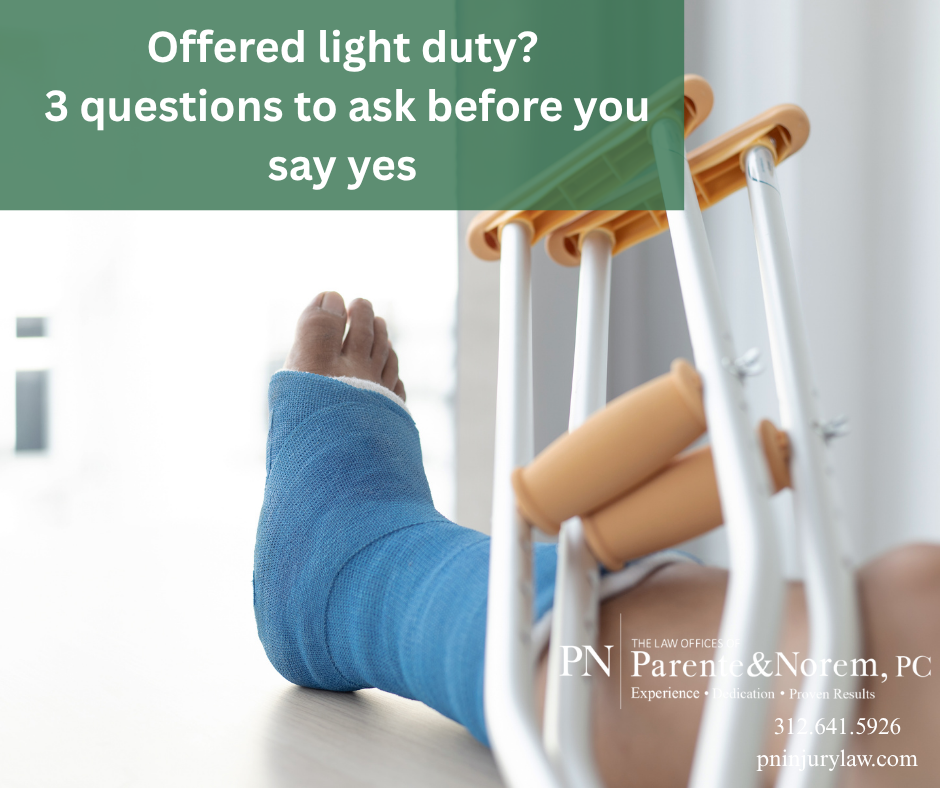

Your doctor cleared you to return to work with restrictions, and now your employer has a "light duty" job ready for you. It can feel like good news. You get a paycheck again, you're back with your coworkers, and life starts to feel normal.
Before you sign anything or show up for your first shift, slow down. In an Illinois workers' compensation case, how you handle a light duty offer can affect your benefits, your recovery and your claim.
What does "light duty" actually mean?
Many injured workers don't realize that "light duty" is not one thing. No single legal definition says what a light duty job must look like. It is whatever the employer writes on the form.
For one worker, light duty might mean answering phones at a desk. For another, it might mean "limited lifting" that still involves loading boxes for eight hours. Two employers can use the same words and mean completely different jobs.
That's why the label matters less than the details. What counts is what you'll be asked to do, for how long, and whether it fits the restrictions your doctor put in writing.
Why should you read the restrictions twice?
Your employer offered you light duty. Before you say yes, read the restrictions twice: first your doctor's, then your employer's.
Your treating physician's restrictions are specific for a reason. They may limit how much you can lift, how long you can stand, whether you can bend or climb, or how many hours you can work each day. Your employer's offer should match every one of those limits.
Put the two documents side by side and look for gaps. Does your doctor say no lifting over 10 pounds while the job description says "occasional lifting as needed"? Does your doctor limit you to four-hour shifts while the offer lists a full schedule? Vague wording is a warning sign. If a restriction isn't clearly addressed, you may be the one who pays for it with a setback in your recovery.
What 3 questions should you ask before accepting light duty?
1. Does this job actually fit my doctor's restrictions?
Ask for a written description of the duties, and share it with your doctor if anything is unclear. If you're asked to do something outside your restrictions after you start, write it down and report it. Working through pain to keep a job can turn a temporary injury into a lasting one.
2. What will I be paid, and will workers' comp cover the difference?
Light duty jobs often come with fewer hours or a lower rate. Under the Illinois Workers' Compensation Act, an injured worker who returns to modified work at reduced earnings may be entitled to temporary partial disability (TPD) benefits. These are generally two-thirds of the difference between the worker's pre-injury average weekly wage and what the worker earns in the light duty job. Know your numbers, and make sure those benefits are being paid.
3. How long does this last, and what happens next?
Some light duty assignments are genuine transitional roles. Others are short-lived or set up in a way that makes it hard for the worker to succeed. Ask whether there is an end date, who will review your progress, and what happens if your restrictions change or the position ends.
What happens if you turn down light duty in Illinois?
This is where many workers get into trouble. In general, if an employer offers work that truly fits your medical restrictions and you refuse it, your temporary total disability (TTD) benefits may be suspended. If the offer doesn't match your restrictions, the situation can be very different.
That's why the details matter. Turning down a legitimate offer can cost you, and accepting an unsafe one can hurt you. Every case depends on its facts, and a quick review before you decide can protect both your health and your benefits.
Read More: Can You Turn Down Light Duty After a Work Injury in Illinois?
When should you talk to a Parente & Norem workers' compensation lawyer?
If you've been offered light duty and something doesn't feel right, it's a good time to get answers. Maybe the duties are vague, the pay doesn't add up or the job seems to ignore your restrictions.
The workers' compensation attorneys at The Law Offices of Parente & Norem, P.C., help injured workers across Chicago and Illinois understand their rights and protect their benefits. Call or text (312) 641-5926 or contact us online to talk about your situation.