
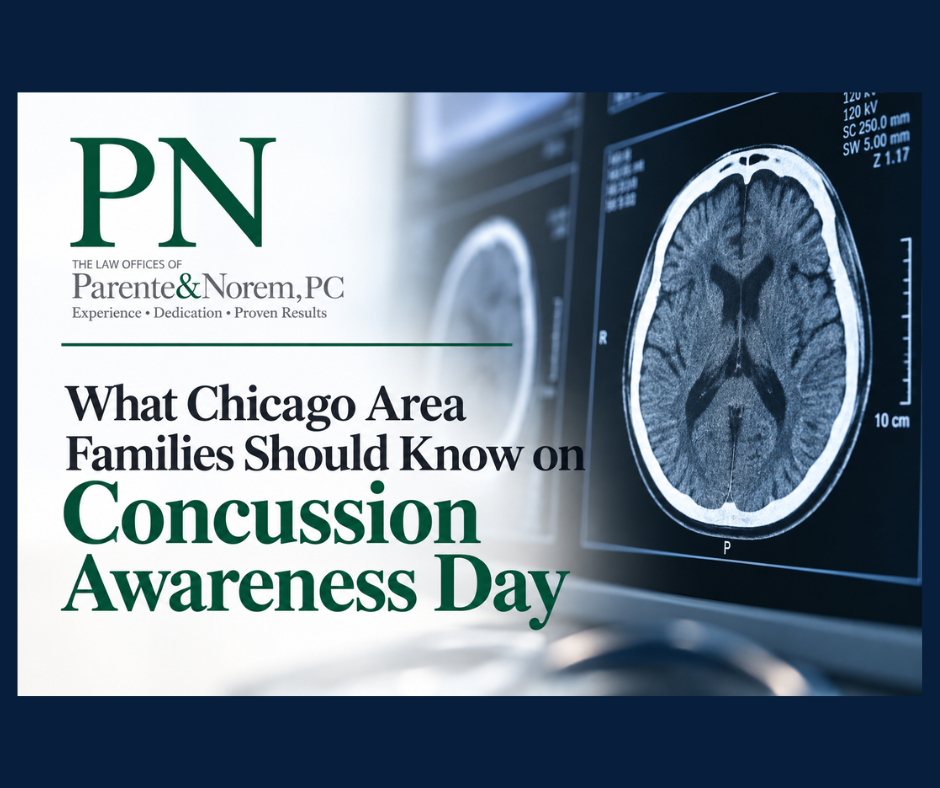

A concussion does not always come with a trip to the hospital. Sometimes it arrives as a headache that will not go away, a fog that settles in during a work meeting, or a parent noticing that a teenager who used to breeze through homework now cannot finish a page. Today, on the tenth annual National Concussion Awareness Day, The Law Offices of Parente & Norem, P.C. joins healthcare providers, coaches, educators and other professionals across the country in urging people to take head injuries seriously, and to understand their rights when someone else caused the harm.
What is National Concussion Awareness Day?
National Concussion Awareness Day is observed on the third Friday of every September and has been recognized by the United States Congress. It was founded in 2016 by Brooke Mills, a high school freshman from New Hampshire who sustained a concussion and wanted others to recognize how often these injuries happen and how seriously they should be treated. The day is built around three simple goals: recognizing a concussion, treating it appropriately and supporting the injured.
That third goal is where our firm lives every day.
Why are concussions called an invisible injury?
A concussion is a mild traumatic brain injury, the word "mild" describing the initial classification, not the effect on a person's life. Roughly 75% of all traumatic brain injuries are mild TBIs, commonly called concussions. Roughly 90% of sports-related concussions occur without any loss of consciousness, which is why so many people assume nothing serious happened.
The symptoms often show up later and rarely appear on a standard X-ray: headaches, dizziness, light and noise sensitivity, memory lapses, irritability, sleep disruption, anxiety and trouble concentrating. Weeks after a crash, an injured person may look completely normal to an insurance adjuster while being unable to do the job they held for twenty years.
That gap between how an injury looks and how it feels is the central challenge in a brain injury claim, and it is the reason these cases demand experienced handling.
Read More: Why Serious Head Injuries Are Often Missed After a Car Crash
How common are traumatic brain injuries?
The CDC reports that traumatic brain injury is a major cause of death and disability in the United States, accounting for more than 586 TBI-related hospitalizations and 190 TBI-related deaths every day. These figures exclude the many TBIs treated only in emergency departments, urgent care or primary care, or that go untreated entirely. Adults age 75 and older experience the highest rates.
Falls account for the greatest number of TBI-related emergency department visits and hospitalizations, while motor vehicle crashes remain the leading cause of TBI-related death.
What causes brain injuries in cases we handle?
In our practice, traumatic brain injuries most often arise from:
- Motor vehicle and truck collisions, including rear-end impacts at surprisingly low speeds and crashes involving commercial carriers
- Pedestrian and bicycle crashes on city streets, where there is nothing between a person's head and the pavement
- Falls on negligently maintained property such as unlit stairwells, uncleared ice, missing handrails, unmarked wet floors
- Construction and workplace incidents, including falls from height, falling objects and struck-by injuries
- Nursing home falls caused by inadequate supervision or failure to follow a resident's care plan
- Medical negligence, including oxygen deprivation at birth and failure to diagnose a bleed on the brain
How does Parente & Norem help people with TBIs caused by negligence?
For more than twenty years, Parente & Norem has represented injured people and families throughout Cook County and across Illinois. Traumatic brain injury cases sit at the intersection of nearly every area our firm handles from motor vehicle collisions, construction accidents, premises liability, workers' compensation and medical malpractice. Here’s how Parente & Norem can help you or a loved one suffering from a TBI:
Proving an injury the defense calls invisible. We work with treating physicians, neurologists, neuropsychologists and life care planners to document cognitive deficits objectively, rather than leaving a jury to rely on how someone appears on the witness stand.
Building the "before and after" record. Teachers, supervisors, coworkers, coaches and family members can describe the person our client used to be. That testimony is often more persuasive than any scan.
Preserving evidence quickly. Black box and dash camera data, surveillance footage, incident reports and maintenance records disappear fast. Early investigation protects the claim.
Pursuing every available avenue of recovery. An injured worker may have both a workers' compensation claim under the Illinois Workers' Compensation Act and a separate third-party negligence claim against a contractor, property owner or driver. Missing the second one can cost a family the cost of a lifetime of care.
Calculating the full lifetime cost. Brain injuries follow people into retirement. Our damages analysis accounts for future medical treatment, cognitive rehabilitation, lost earning capacity, in-home support and the effect on a family.
What should you do after a head injury caused by someone else?
- Get medical attention the same day, even if you feel fine. Symptoms are frequently delayed.
- Tell the provider exactly how your head was struck or jolted and ask that it be documented.
- Report the incident to the police, your employer or the property owner, and request a copy.
- Write down symptoms daily; headaches, mood changes, missed words, lost sleep. A simple journal becomes powerful evidence.
- Do not give a recorded statement to an insurer before speaking with one of Parente & Norem’s attorneys.
- Follow through on all recommended treatment. Gaps in care are the first thing the defense will point to.
How long do you have to file a brain injury claim in Illinois?
Illinois sets deadlines for filing personal injury lawsuits with different rules for claims. These deadlines are strict, and some are far shorter than people expect. Because the applicable time limit depends entirely on the facts of your case, speak with one of our attorneys as soon as possible rather than relying on a general rule.
Talk to a Parente & Norem brain injury lawyer
If you or someone you love suffered a concussion or traumatic brain injury because another person, business or property owner was careless, Parente & Norem is ready to listen. Consultations are free, and we handle injury cases on a contingency fee basis which means you owe no attorney's fee unless we recover for you. Call or text us today at (312) 641-5926