
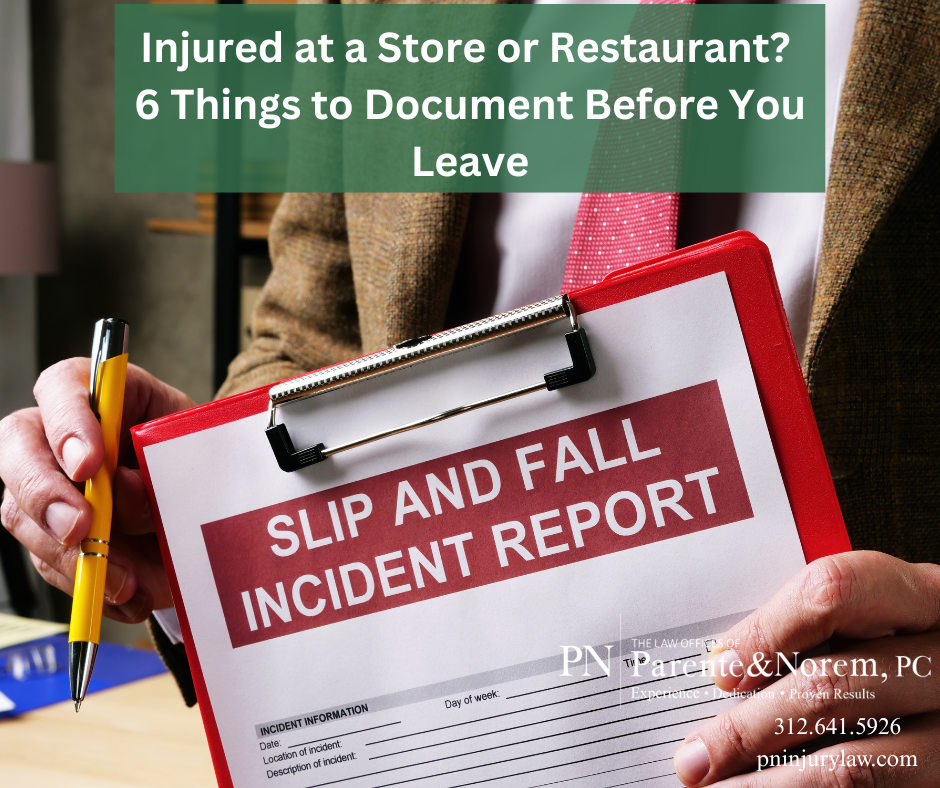

One moment you're grabbing groceries or waiting for a table. The next, you're on the floor, embarrassed, hurting, and unsure of what to do. Most people's first instinct after falling in a store or restaurant is to get up, brush it off, and get out as quickly as possible.
That instinct is understandable. It's also the single biggest mistake injured customers make.
Premises liability cases are won and lost on evidence, and the most important evidence often exists for only minutes after the accident. A spilled drink gets mopped up. A broken tile gets repaired. Security footage gets recorded over. Witnesses walk out the door and are never found again.
If you're hurt at a business in Chicago or anywhere in Illinois, here are six things to document before you leave, and why each one can make or break your case later.
1. Why Are Photos of the Hazard So Important?
Take photos and video of whatever caused your injury before anything changes. That means the puddle, the torn carpet, the icy walkway, the broken handrail, the poorly lit stairwell, whatever it was, capture it from multiple angles and distances.
Include context in your shots:
- A wide shot showing where the hazard was located in the store or restaurant
- Close ups showing the size and nature of the hazard
- Anything nearby that matters, such as a missing "wet floor" sign, a leaking cooler, or an employee station with a clear view of the area
- Lighting conditions, if poor visibility played a role
Why it wins cases later: Under Illinois law, an injured customer generally must show that the business knew or should have known about the dangerous condition. Photos taken in the moment can show how large a spill was, how dirty or tracked through it had become, or how long a hazard had clearly existed; the important details that help prove the business had time to discover and fix it. Once the hazard is cleaned up or repaired, that proof is gone forever. Your phone camera preserves it permanently, with a timestamp.
2. Should I Ask for a Copy of the Incident Report?
Yes, and this step is one people skip most often. Nearly every major retailer and restaurant chain has a policy requiring employees to complete an incident report when a customer is injured. Ask a manager to complete one before you leave, and request a copy or, at minimum, photograph it.
Make sure the report accurately reflects:
- The date, time, and exact location of the incident
- What caused your injury, in plain factual terms
- The names of the employees involved or nearby
If the manager refuses to give you a copy, write down the manager's name, the time you made the request, and the fact that you were refused.
Why it wins cases later: An incident report is a contemporaneous business record created by the business itself, on the day of the accident. It locks in the store's own version of events before an insurance adjuster or defense attorney gets involved. It also defeats a common defense tactic: claiming the injury never happened on their property at all, or that it was never reported. When the business's own paperwork confirms the fall, that argument disappears.
3. Why Do Witness Contacts Matter So Much?
If anyone saw you fall, such as another customer, a delivery driver, even an employee, politely ask for their name and phone number. A short voice memo or text to yourself works fine. If they're willing, ask them to describe in one or two sentences what they saw, and note it.
Why it wins cases later: Premises liability cases frequently come down to your word against the business's. An independent witness with no stake in the outcome changes that equation entirely. A fellow customer who can testify, "I walked past that spill twenty minutes earlier and nobody cleaned it up," may single-handedly establish that the business had notice of the hazard which is often the hardest element to prove. But witnesses are nearly impossible to locate after the fact. The window to get their contact information is measured in minutes, not days.
4. What Should I Do With the Shoes and Clothing I Was Wearing?
This one surprises people: preserve your footwear. When you get home, put the shoes you were wearing in a bag and don't wear them again. Don't clean them, and don't clean the clothing you were wearing either, especially if it shows evidence like liquid stains, grease, or debris from the floor.
Why it wins cases later: One of the most common defenses in slip and fall cases is blaming the victim's footwear arguing that worn out soles, high heels, or "inappropriate" shoes caused the fall, not the hazard. Preserving your shoes in their exact condition lets your attorney prove they had adequate tread and were appropriate for the setting, shutting down that defense before it gains traction. Stains or residue on your clothing can also corroborate exactly what substance was on the floor.
5. How Do I Make Sure Security Camera Footage Isn't Erased?
Most stores and restaurants have surveillance cameras, and there's a good chance your accident, and the minutes or hours before it was recorded. The problem: many systems automatically overwrite footage within days or even hours.
Before you leave (or as soon as possible afterward), tell the manager, in writing if you can, that you are requesting the video footage of the incident be preserved. A simple text or email to the business works: "I was injured at your location on [date] at approximately [time]. Please preserve all video footage of the incident and the two hours preceding it." Keep a copy of that message, and note the name of the person you spoke with.
Then contact an attorney quickly. A lawyer can immediately send a formal preservation letter (sometimes called a spoliation letter) that creates a legal obligation for the business to retain the footage.
Why it wins cases later: Video is the closest thing to indisputable evidence in a premises liability case. Footage can show exactly how long a spill sat on the floor, how many employees walked past it, and precisely how your fall happened. And if a business destroys footage after receiving a written preservation request, Illinois courts can impose consequences for the destruction of evidence, which can significantly strengthen your position. Without a prompt request, though, that footage may be legally and permanently gone within days.
6. Why Is Prompt Medical Care Both a Health Issue and a Legal One?
Even if you feel "mostly fine," get evaluated by a medical professional the same day if possible whether at an emergency room, urgent care, or your own doctor. Adrenaline masks pain, and injuries like concussions, soft tissue damage, and hairline fractures often don't fully reveal themselves for days.
Tell the provider exactly how the injury happened and describe every symptom, even minor ones. Then follow through on all recommended treatment and appointments.
Why it wins cases later: Insurance companies scrutinize the gap between the accident and the first medical visit. A same-day medical record creates a clear, documented link between the fall and your injuries. A two week gap, on the other hand, invites the argument that you weren't really hurt, or that something else caused your injuries in the meantime. Consistent, prompt medical treatment is often the difference between a fully valued claim and one the insurer fights at every turn.
What Should I Do After I Leave?
Once you're home and safe, a few follow up steps protect everything you documented:
- Write down your own account of what happened while it's fresh, including times, employee names, and conversations
- Save receipts proving you were a customer at the location that day
- Avoid posting about the accident on social media
- Don't give a recorded statement to the business's insurance company before speaking with an attorney
Injured at a Business? Talk to The Law Offices of Parente & Norem, P.C.
The moments after an injury at a store or restaurant are stressful, but the evidence you preserve in those moments can shape the entire outcome of your case. If you or a loved one has been hurt on someone else's property, the premises liability attorneys at Parente & Norem are ready to investigate, preserve critical evidence, and fight for the compensation you deserve.
Consultations are always free, and you pay nothing unless we win your case. Call or text us today at (312) 641-5926 to get started. Your path to justice begins with us.