
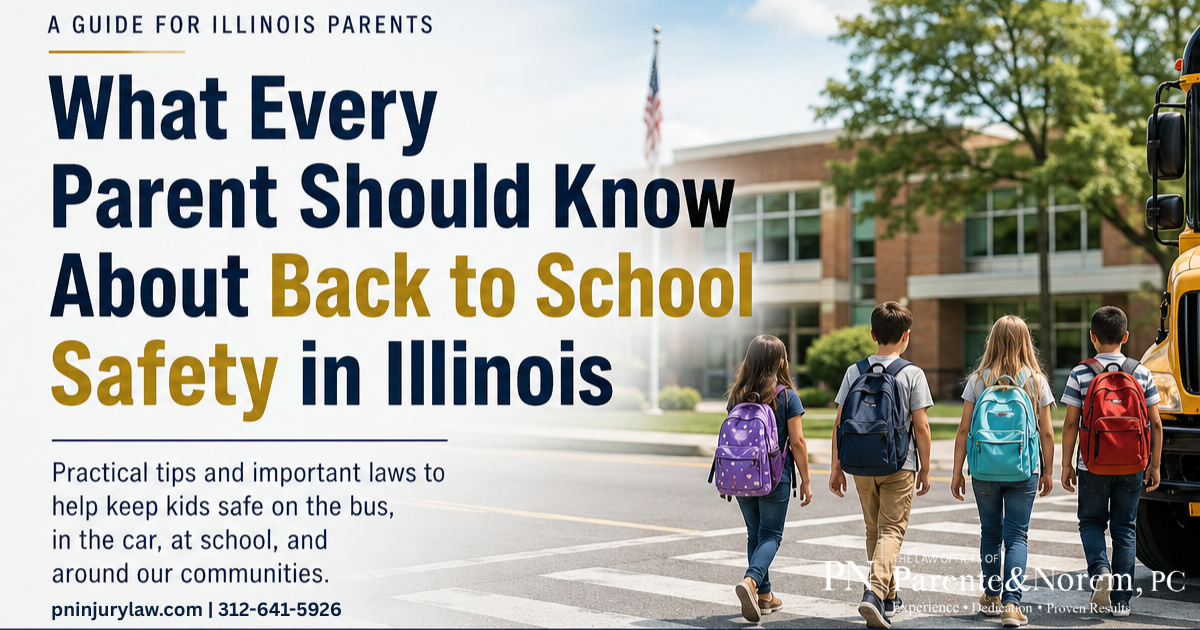

Every August, hundreds of thousands of Illinois children return to classrooms, and with them come yellow buses making frequent stops, crossing guards stepping into intersections, and young pedestrians and bicyclists filling sidewalks and crosswalks during the morning and afternoon rush. For drivers, the start of the school year is a legal reset as much as a seasonal one. Illinois law imposes specific, heightened duties on motorists around school buses, school zones, and crosswalks. When a driver ignores those duties and a child is hurt, the consequences extend far beyond a traffic ticket.
At The Law Offices of Parente & Norem, P.C., we believe the best outcome is always the accident that never happens. This guide covers the key Illinois laws that protect children on their way to and from school, the most common driver mistakes that put students at risk, and what families should know about their legal rights if the unthinkable occurs.
What Does Illinois Law Require When a School Bus Stops?
Illinois has one of the most comprehensive school bus stop laws in the country. In Illinois, drivers must come to a complete stop before meeting or overtaking, from either direction, any school bus that is stopped to pick up or drop off students. The law applies on highways, roadways, private roads, parking lots, school property, and virtually any other location where a bus is loading or unloading children.
The requirement is triggered when the bus activates its visual signals: flashing red lights and the extended stop-signal arm. Once stopped, drivers may not proceed until one of three things happens: the bus resumes motion, the bus driver signals traffic to proceed, or the visual signals are turned off.
There is one narrow exception. On a roadway with four or more lanes, where at least two lanes travel in the opposite direction of the bus, drivers heading in the opposite direction are not required to stop. On a standard two-lane road, however, traffic in both directions must stop, no exceptions.
What Are the Penalties for Passing a Stopped School Bus in Illinois?
Illinois significantly strengthened its stop-arm penalties in 2020. A first conviction for illegally passing a stopped school bus now carries a $300 fine, and a second or subsequent violation carries a $1,000 fine. Just as significantly, a first conviction results in a mandatory three-month suspension of driving privileges by the Illinois Secretary of State, and a second conviction within five years results in a one-year suspension.
Many Illinois school districts have also equipped buses with stop-arm cameras, and bus drivers can report violations directly to local law enforcement. In other words, the days of an illegal pass going unnoticed are largely over.
But the penalties tell only part of the story. Children boarding or exiting a bus are among the most vulnerable road users anywhere. They may dart out unexpectedly, they cannot accurately judge vehicle speed or distance, and they are often hidden from a driver's view by the bus itself. That is precisely why the law demands a full stop, and why a driver who blows past an extended stop arm and strikes a child can face civil liability in addition to criminal penalties.
How Fast Can You Drive in an Illinois School Zone?
The speed limit in an Illinois school zone is 20 miles per hour on school days when children are present and within close proximity to the roadway. School days generally cover the hours when students are traveling to and from school, and posted school zone signs mark where the reduced limit applies.
Speeding in a school zone is not treated like an ordinary speeding ticket. Fines are enhanced, and a violation that results in a crash can serve as powerful evidence of negligence in a civil case. Illinois courts recognize that the 20 mph limit exists for a simple physical reality that the difference between 20 mph and 35 mph can be the difference between a driver stopping in time and a catastrophic injury. Research on pedestrian collisions consistently shows that a child's chance of surviving a crash drops sharply as vehicle speed increases.
Drivers in school zones should also expect the unexpected such as crossing guards entering the roadway, children chasing a dropped backpack, bicycles swerving off sidewalks. Under Illinois law, motorists must exercise due care to avoid colliding with any pedestrian, and that duty is heightened where children are known to be present.
Who Has the Right-of-Way at Crosswalks in Illinois?
Illinois law is clear, drivers must stop and yield the right-of-way to a pedestrian crossing the roadway within a crosswalk. This applies at marked crosswalks and, at intersections, at unmarked crosswalks as well. Drivers are also prohibited from overtaking and passing another vehicle that has stopped at a crosswalk to let a pedestrian cross; a rule that exists because the stopped car often blocks the passing driver's view of the very child who is crossing.
Where a crossing guard is present, their signals control. Ignoring a crossing guard's raised stop sign is both a traffic violation and, in the event of a collision, compelling evidence of negligence.
Parents can reinforce these protections by teaching children to cross only at corners and crosswalks, make eye contact with drivers before stepping into the street, and avoid distractions like phones and headphones while crossing. But the law places the primary burden where it belongs, on the driver operating the multi ton vehicle.
Why Are Teen Drivers a Back-to-School Risk Factor?
The back-to-school season also puts more inexperienced drivers on the road, many of them driving themselves to school for the first time. Motor vehicle crashes remain a leading cause of death for teenagers in the United States, and crash risk is highest in the first months of licensure.
Illinois addresses this risk through its Graduated Driver Licensing (GDL) program, which phases in driving privileges for new drivers. Key restrictions include nighttime driving curfews, limits on the number of unrelated passengers under age 20 during the first year of licensure, and a strict prohibition on cell phone use for drivers under 19, even hands-free.
For parents of teen drivers, the start of the school year is a good moment to revisit rules like no phones, seat belts for every occupant, and a firm understanding that the school parking lot and surrounding streets are among the most chaotic driving environments a new driver will face. For everyone else on the road, it is a reminder to drive defensively near high schools, where inexperience, distraction, and congestion converge twice a day.
Who Is Liable When a Negligent Driver Injures a Child?
When a child is struck by a vehicle near a school, a bus stop, or a crosswalk, the legal analysis begins with negligence. Did the driver fail to exercise reasonable care under the circumstances? Evidence that the driver violated a safety statute such as passing a stopped school bus, speeding in a school zone, failing to yield at a crosswalk, or texting behind the wheel, can be powerful proof that the driver breached their duty of care.
Depending on the circumstances, liability may extend beyond the individual driver. Potentially responsible parties can include:
- The at-fault driver and their insurer, in the most common scenario
- A driver's employer, if the driver was working at the time of the crash. For example, a delivery driver on route
- A bus company or school transportation contractor, if bus driver negligence or improper stop procedures contributed to the injury
Compensation in a child injury case may address medical expenses, future care needs, pain and suffering, disability or disfigurement, and the family's related losses. Because a child's injuries can affect growth, development, and future earning capacity, these cases often require careful long-term evaluation by medical and economic experts.
How Long Does a Family Have to File a Claim in Illinois?
Because deadlines and evidence preservation windows can be short, surveillance footage is overwritten, vehicle data is lost, witness memories fade, families should consult an attorney promptly after any serious incident, even while a child is still receiving treatment.
A Family Safety Checklist for the New School Year
For drivers:
- Build extra time into your morning commute so you're never tempted to pass a bus or speed through a school zone.
- Treat every extended stop arm as an absolute stop on two-lane roads, in both directions.
- Put the phone away. Illinois prohibits handheld device use for all drivers, and school zones demand full attention.
- Watch for children between parked cars, at bus stops, and near school driveways during pickup and drop-off hours.
For parents:
- Walk your child's route to school and identify the safest crossing points.
- Teach children to wait for the bus driver's signal before crossing in front of a bus, and to cross at least ten feet ahead of the bus where the driver can see them.
- Set clear GDL-based rules for teen drivers and model good habits yourself.
Parente & Norem Has Been Committed to Protecting Illinois Families for Decades
The attorneys at The Law Offices of Parente & Norem, P.C. have spent decades standing up for injured people and their families throughout Chicagoland and Illinois. If your child has been injured by a negligent driver whether near a school, at a bus stop, in a crosswalk, or anywhere else, our team is here to answer your questions, explain your options, and fight for the full compensation your family deserves. Consultations are always free, and you pay nothing unless we win.
Call Parente & Norem at (312) 641-5926 or visit pninjurylaw.com to schedule your free consultation.